
AI & ML Projects for Quality and Safety
Our quality and safety projects leverage AI and ML to improve the accuracy, efficiency, and safety of radiation therapy treatments.
1. AI Automated Contouring
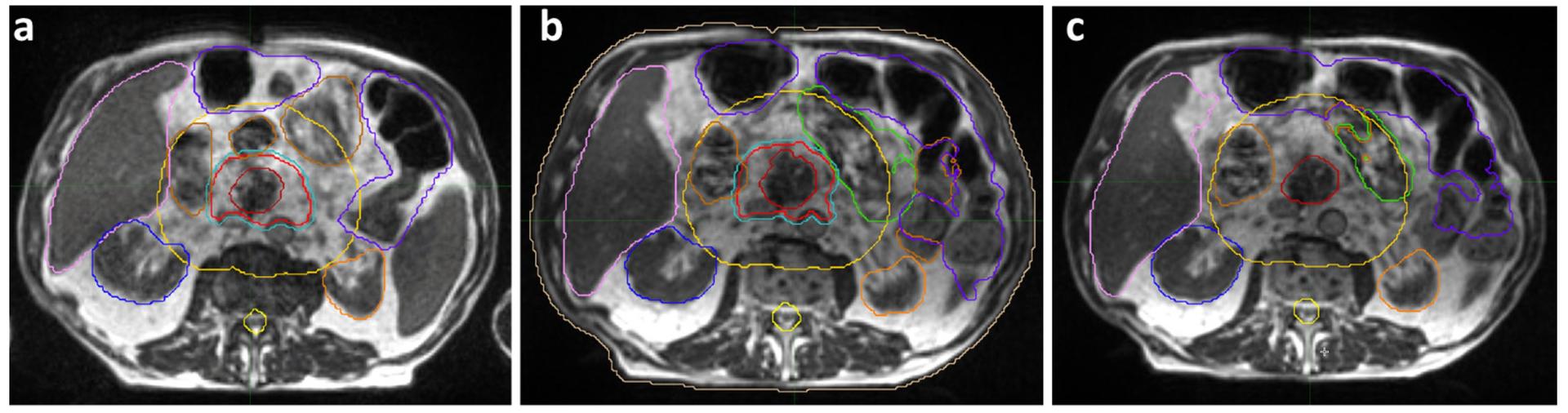
Contouring of organs is an essential part of the radiation treatment planning process that is used to determine how much dose is being deposited into each part of the body. Up until 2023, the process of contouring was manually performed by physicians, taking an average of 30 minutes per patient.
In the summer of 2023, we implemented an AI-based automated contouring tool for generating auto contours and quality assurance of the developed contours. Since the AI-based automated contouring tool has been in place, >95% of patients have their contours generated automatically in five minutes, resulting in a six-fold improvement in efficiency.
2. AI Automated Radiation Treatment Planning
The radiation treatment planning process has traditionally been considered a manual process where the user selects radiation machine parameters to produce an optimal treatment plan for the patient.
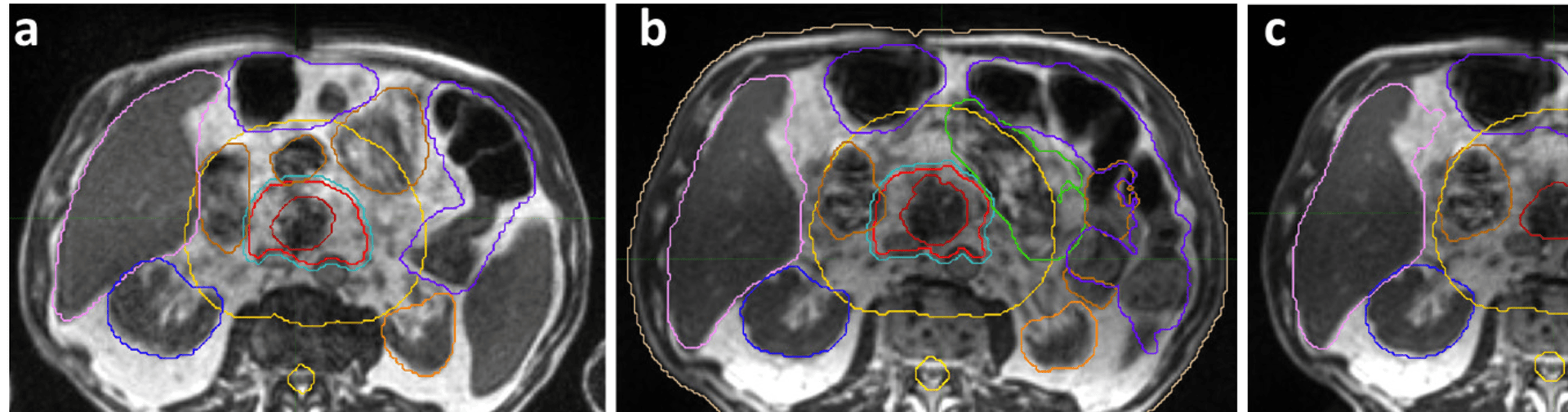
In 2022, the department implemented an AI-based automated treatment planning solution. The AI-automated treatment planning tool improves the quality of radiation treatment plans by reducing doses to organs surrounding the tumor. It improves efficiency by reducing the time by 50% that it takes to generate a treatment plan for any patient.
3. ML Solutions for Adaptive Radiotherapy
The typical radiation therapy planning process takes two weeks from when a patient is seen in consultation and when they can begin their radiation treatment. Adaptive radiotherapy is a process where a patient's treatment plan is adapted on the day of treatment based on the patient's daily anatomy.
The adaptive process typically takes an hour and occurs while the patient lies on the treatment machine (Linear Accelerator). Using ML methods, Radiation Oncology researchers have developed automated methods to reduce the adaptive process by 50% to 30 minutes.
4. Computer Vision Assisted Surface-Guided Radiation Therapy
Standard radiotherapy approaches rely on marks on the skin to reproducibly set up a patient for radiotherapy. Recent approaches have proposed using patient surface guidance and optical imaging to improve patient set-up accuracy.
Although surface-guided approaches improve patient set-up accuracy, the methods often fail for patients of different skin color, body mass index, body habitus, and body type. Jefferson investigators have designed a novel AI approach to enhance surface-guided radiotherapy.
The concept is called 'Avatar guided radiotherapy' and employs AI-driven patient-specific "avatars" to improve the internal and external correspondence from a given surface scan. The impact of Avatar-guided RT is that it can enhance radiotherapy set-up accuracy for a diverse population, including patients with different skin colors and body habitus.
The work was recognized at the 2024 annual American Association of Physics in Medicine meeting as a "Best in Physics" abstract (given to the top 1% of submissions), and the investigators have filed a complete patent for the work.
5. ML for Radiation Treatment Machine Quality Assurance
Radiation therapy treatment machines, known as Linear Accelerators, are complex hardware and software systems that produce thousands of data points for every patient treatment.
Quality assurance of Linear Accelerators has been a manual process that is 1) time-consuming, 2) able to evaluate only a finite amount of data, and therefore 3) not able to predict imminent machine failures.
Radiation Oncology researchers have developed a convolution neural network (CNN) that prospectively identifies which machine components may perform sub-optimally. The neural network's ability can significantly improve error detection rates, reduce the amount of patient treatment delays, and improve clinical outcomes.
6. AI Model for Mono-isocenter Multiple Brain Metastasis SRS
Brain metastasis is the most common intracranial cancer in adults. Radiation plays a central role in the management of brain metastasis. Currently, stereotactic radiosurgery (SRS) is the treatment of choice for patients with limited brain metastasis based on multiple phase 3 randomized trials.
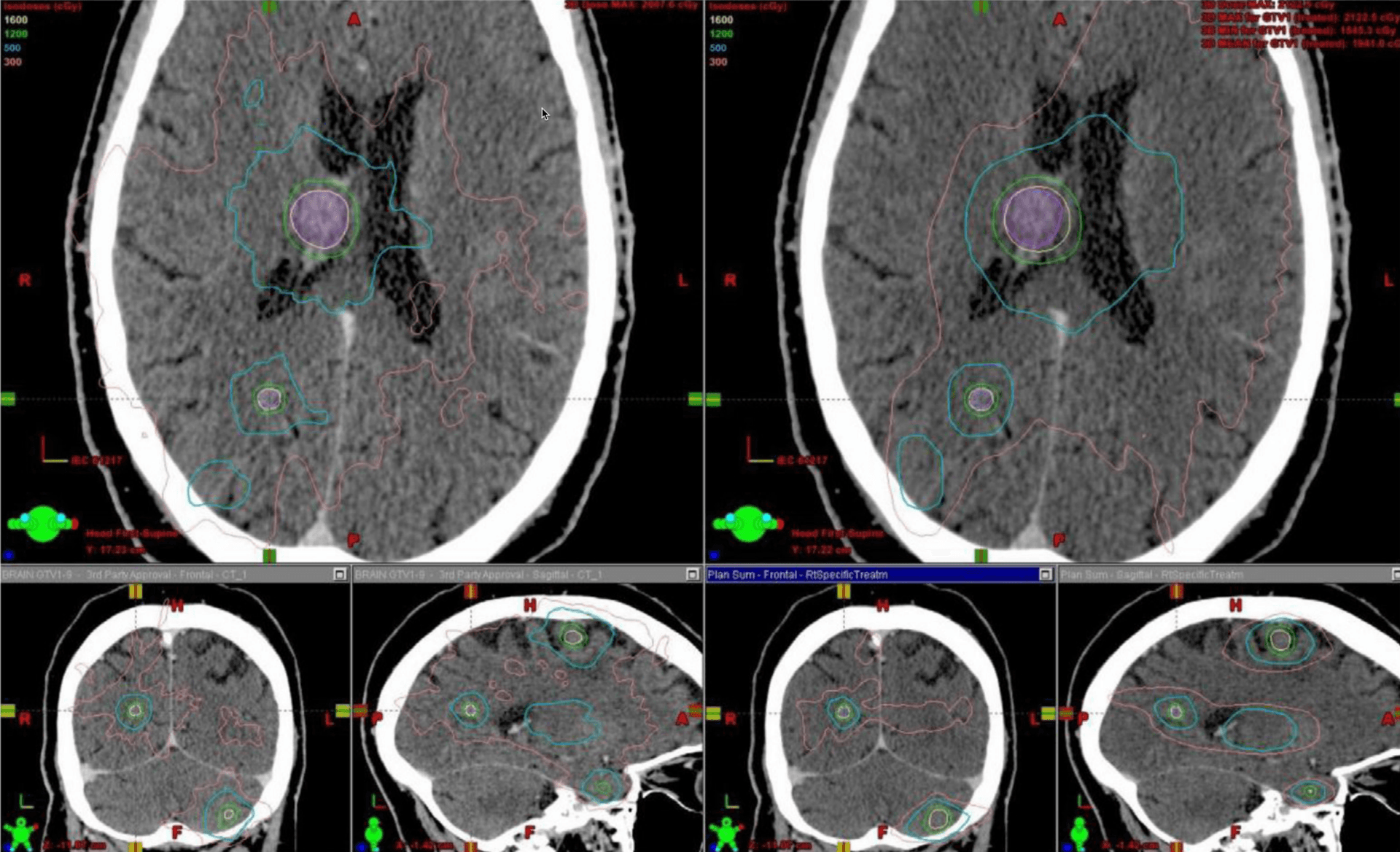
SRS is also a standard-of-care option for patients with multiple brain metastasis (>4). Mono-isocenter multiple brain metastasis SRS is gaining popularity to improve efficiency and patient comfort. However, well-established criteria are needed to evaluate radiation plan optimization. Numerous studies demonstrated there is high interobserver variability.
Our group developed a deep-learning model for optimized SRS plans to predict patient-specific 3D dose distribution. The current model is being validated with an expanded cohort of patients. Our AI model can be used for efficient plan quality evaluation to identify sub-optimal plans.
The work is funded by philanthropic funding with plans for a National Cancer Institute (NCI) R21 submission in 2025.