

AI & ML Research Projects
Our comprehensive portfolio of AI and ML projects spans three key areas: improving quality and safety, reducing treatment side effects, and enhancing cancer cure rates. Together, these initiatives represent our commitment to transforming radiation oncology through computational innovation.
$8M+
in AI-related grants
11
active AI/ML grants
4
prospective clinical trials
15
invention disclosures
Funded by: NIH, NCI, AHRQ, MIM Software, Varian, Elekta, ACS, and SKCCC
Quality & Safety Projects
Our quality and safety projects leverage AI and ML to improve the accuracy, efficiency, and safety of radiation therapy treatments, enhancing patient outcomes while reducing treatment time and errors.
Contouring of organs is an essential part of the radiation treatment planning process that is used to determine how much dose is being deposited into each part of the body. Up until 2023, the process of contouring was manually performed by physicians, taking an average of 30 minutes per patient.
In the summer of 2023, we implemented an AI-based automated contouring tool for generating auto contours and quality assurance of the developed contours. Since the AI-based automated contouring tool has been in place, >95% of patients have their contours generated automatically in five minutes, resulting in a six-fold improvement in efficiency.
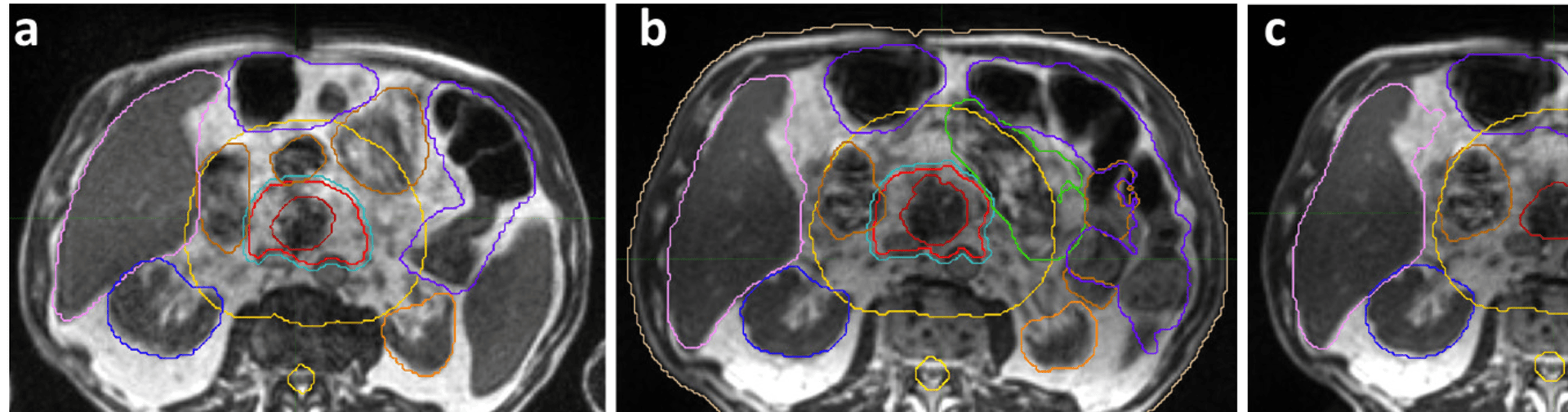
The radiation treatment planning process has traditionally been considered a manual process where the user selects radiation machine parameters to produce an optimal treatment plan for the patient.
In 2022, the department implemented an AI-based automated treatment planning solution. The AI-automated treatment planning tool improves the quality of radiation treatment plans by reducing doses to organs surrounding the tumor. It improves efficiency by reducing the time by 50% that it takes to generate a treatment plan for any patient.
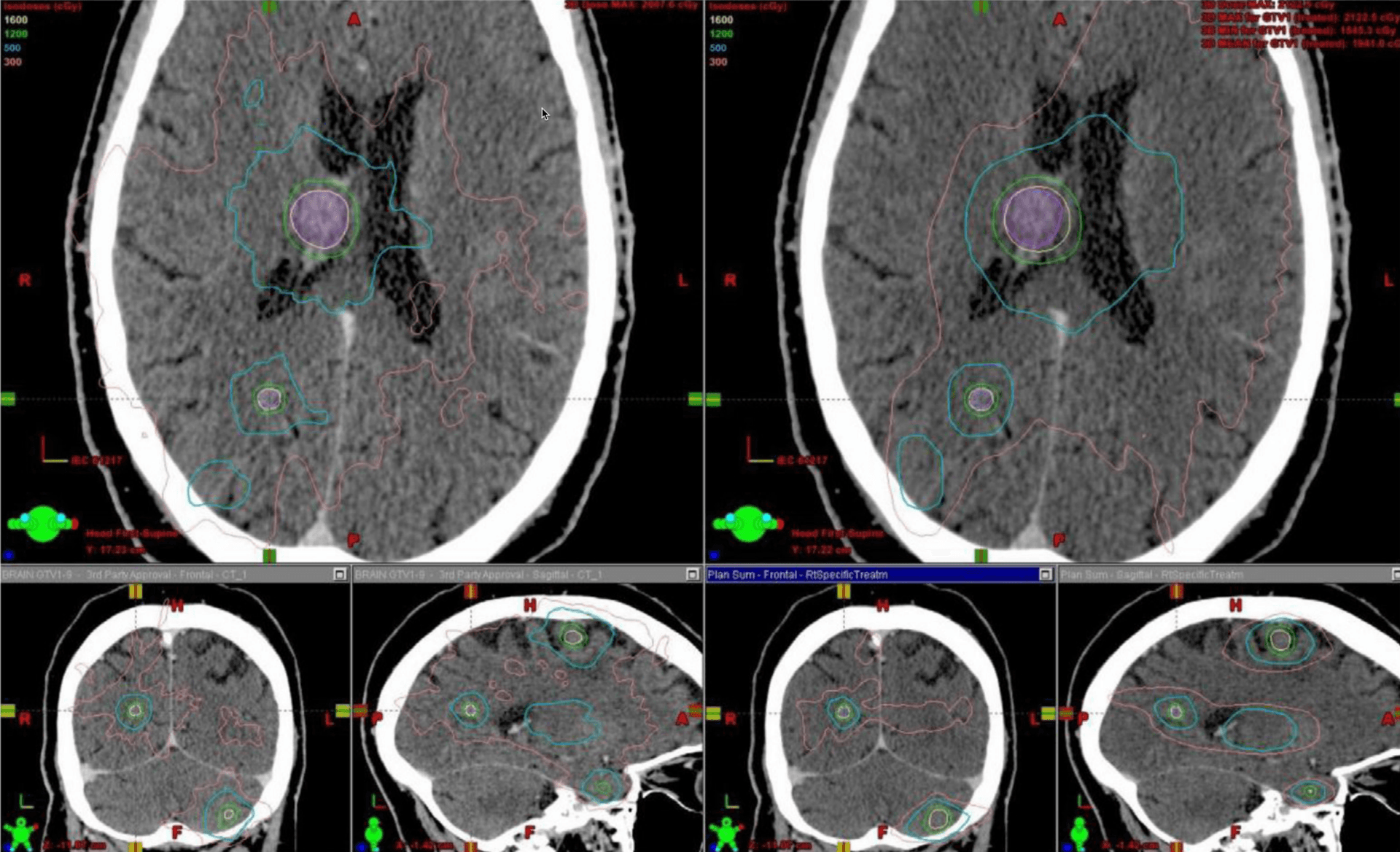
Brain metastasis is the most common intracranial cancer in adults. Radiation plays a central role in the management of brain metastasis. Currently, stereotactic radiosurgery (SRS) is the treatment of choice for patients with limited brain metastasis based on multiple phase 3 randomized trials.
Our group developed a deep-learning model for optimized SRS plans to predict patient-specific 3D dose distribution. The current model is being validated with an expanded cohort of patients. Our AI model can be used for efficient plan quality evaluation to identify sub-optimal plans.
Advancing Cancer Care Through AI
Our AI and ML initiatives have secured over $8 million in grant funding, launched 4 prospective clinical trials, and engaged 17 faculty members in cutting-edge research. Join us in our mission to transform radiation oncology.